

Orthodontics After 40: Braces and Invisalign for Adults
September 22, 2026

A big share of orthodontic patients are adults now. The American Association of Orthodontists says roughly one in three orthodontic patients is an adult, and its 2025 member survey estimated about 1.91 million adults in active treatment with AAO orthodontists in the United States, up from about 1.64 million two years earlier.
A lot of those patients are over 40. Some never had treatment as kids. Many had braces decades ago, stopped wearing their retainers, and gradually noticed their teeth shifting. Some are referred by their dentist because of crowding, unfavorable tooth position, or bite concerns that need to be addressed before damaged or missing teeth can be predictably restored with crowns, bridges, implants, or other restorative treatment.
Orthodontic treatment after 40 is not simply adolescent treatment performed later in life. The same principles of tooth movement apply, but adults often have additional considerations involving periodontal health, previous dental treatment, missing teeth, restorations, tooth wear, and changes that have developed over time. These factors are very important and directly influence decisions about the most appropriate and predictable treatment plan for each patient.
Key Takeaways
- Age isn't what decides whether you can have treatment. Healthy teeth can be moved at almost any age. We treat patients in their 40s, 50s, 60s, and 70s all the time.
- Gums and bone health matter more than your age. Active periodontal disease, untreated decay, and other dental conditions should be addressed before orthodontic forces are applied.
- Existing dental work affects treatment planning. Crowns, bridges, veneers, implants, root canal-treated teeth, and missing teeth may influence how orthodontic treatment is designed. Dental implants are integrated into the bone and cannot be moved orthodontically.
- Adult treatment can progress differently. Adults no longer have jaw growth available to assist with certain corrections, and biologic response to orthodontic forces may be more gradual in some patients.
- Relapse is one of the most common reasons adults return for orthodontic treatment. Teeth that have shifted after previous orthodontic treatment can often be corrected, and some patients may qualify for limited treatment rather than another full course of comprehensive orthodontics.
Why More Adults Are Seeking Orthodontic Treatment
Common Reasons Adults Start Treatment After 40
- Crowding that developed or became more noticeable over time
- Relapse after previous orthodontic treatment
- Retainers that were discontinued or no longer fit
- Spacing that developed over the years
- Bite problems that were never treated
- Difficulty cleaning crowded or overlapping teeth
- Uneven tooth wear or chipping
- Preparation for crowns, bridges, veneers, or implants
- Teeth that shifted after the loss of another tooth
- Long-standing concerns about smile appearance
Treatment Is Frequently Recommended by a Dentist
Many of our adult patients are referred by their general dentist or another dental specialist.
When teeth are crowded, tipped, rotated, over-erupted, or positioned unfavorably, restorative treatment can become more difficult to perform and maintain. In appropriate cases, repositioning the teeth before restorative treatment can create a more favorable foundation for the final restoration and may allow treatment to be more conservative.
When orthodontic treatment is part of a larger restorative plan, we coordinate closely with your dentist, periodontist, prosthodontist, oral surgeon, or other dental specialists involved in your care.
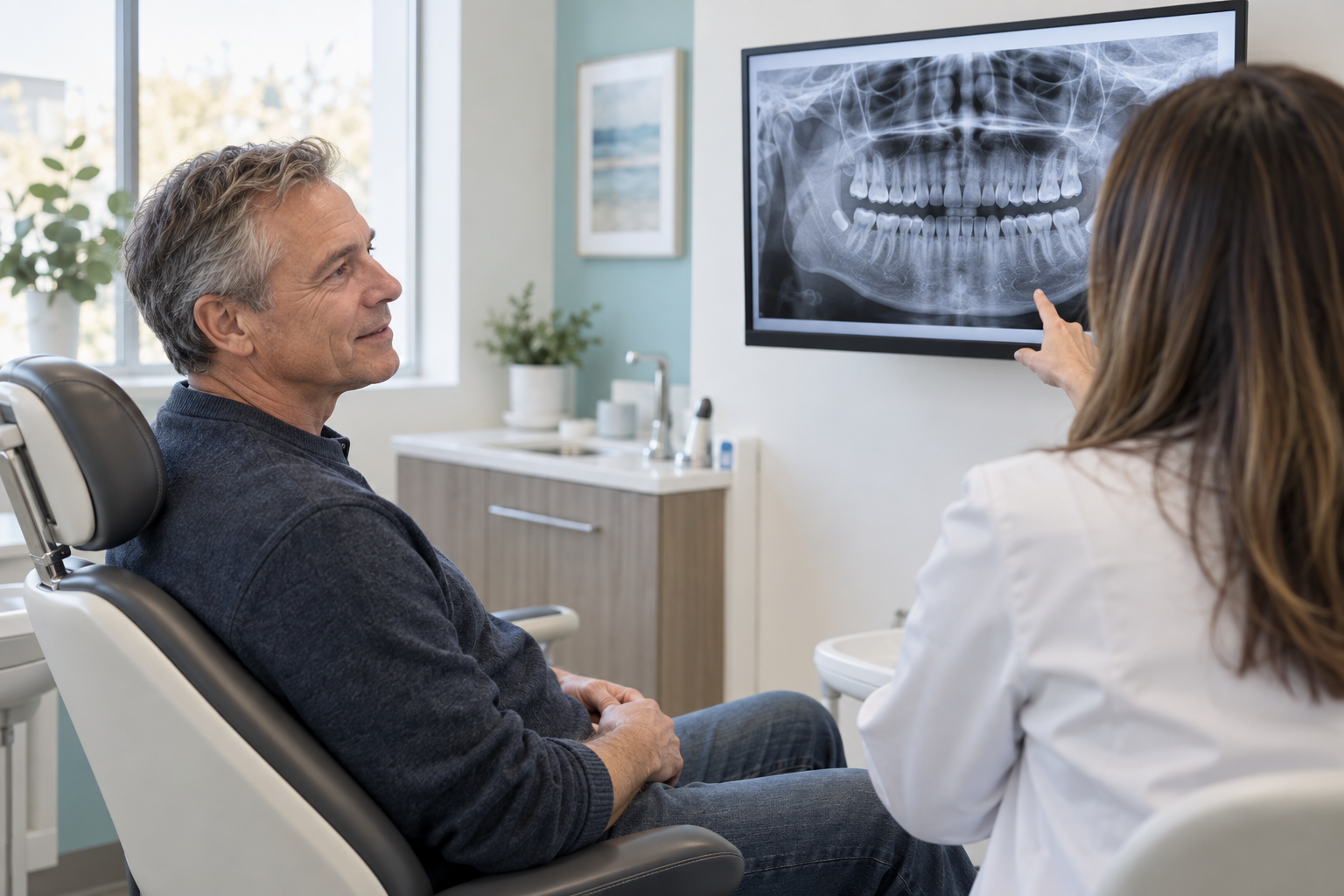
What Changes About Orthodontic Treatment After 40
Adult Patients Are No Longer Growing
In children and adolescents, certain orthodontic treatments can take advantage of remaining jaw growth. Some skeletal corrections that are possible during growth are no longer possible once growth is complete.
In adults, we work with the underlying skeletal structure as it exists. Many bite problems can still be improved successfully through orthodontic tooth movement alone. In cases involving a significant skeletal jaw discrepancy, orthodontic treatment combined with orthognathic surgery may be considered.
If your case falls into this category, Dr. Parsons will explain the findings, available options, and limitations clearly so you can make an informed decision.
Tooth Movement May Be Slower
Research on adult orthodontics indicates that teeth may move more slowly in adults than in adolescents, and that the surrounding bone responds a bit differently to orthodontic force as we age.
This does not prevent successful treatment. It simply reinforces the importance of using carefully controlled forces, appropriate mechanics, regular monitoring, and a treatment timeline based on your individual biology rather than attempting to accelerate movement unnecessarily.
Periodontal Health Is Very Important for Orthodontic Treatment
Periodontal health is one of the most important considerations in adult orthodontic treatment. Teeth with reduced bone support can often still be moved successfully, but treatment mechanics, force levels, and monitoring must take that reduced support into account. Active periodontal disease should be treated and stabilized before orthodontic treatment begins.
If you have a history of periodontal disease or bone loss, we may recommend more frequent periodontal maintenance during orthodontic treatment and coordinate your care directly with your periodontist.
For adults with periodontal concerns, successful orthodontic treatment is often a collaborative process involving both the orthodontist and the periodontal team.
Pre-Existing Dental Conditions and Restorations Are Important Considerations
Adults frequently begin orthodontic treatment with existing dental restorations or previous dental treatment. Treatment planning may need to account for:
- Crowns and bridges, which may require different bonding techniques than natural enamel
- Veneers, which require careful attachment or bracket placement
- Dental implants, which are integrated into the bone and cannot be moved orthodontically
- Missing teeth and changes in tooth position that occurred after tooth loss
- Root canal-treated teeth
- Large fillings or structurally compromised teeth
- Previous dental extractions
- Existing tooth wear, cracks, or fractures
Dental implants are especially important to identify during the initial planning process because their position is fixed and may influence the movement and final position of the surrounding teeth.
Best Orthodontic Treatment Options for Adults
Invisalign and Clear Aligners
Clear aligners are among the most requested orthodontic options for adults, and they can be an excellent choice for many adult cases.
Adults often appreciate that aligners are:
- Discreet in professional and social settings
- Removable for eating, brushing, and flossing
- Free of brackets and wires that may irritate the cheeks or lips
- Adaptable to many situations involving existing dental restorations
- Convenient for patients with demanding work and travel schedules
Successful aligner treatment requires consistent wear, typically about 20 to 22 hours per day. Most importantly, whether Invisalign or another clear-aligner approach is appropriate depends on the type and complexity of tooth movement required. Appliance selection should be based on what will predictably accomplish the treatment goals, not appearance or convenience alone.
Ceramic Clear Braces
Ceramic braces use tooth-colored or translucent brackets that are less noticeable than traditional metal braces. Because they remain attached to the teeth throughout treatment, they do not depend on the patient remembering to wear an appliance. For adults who prefer a more discreet appearance but whose treatment may benefit from fixed appliances, ceramic braces can be an excellent option.
Lingual Braces
Lingual braces are attached to the tongue side of the teeth, making them virtually invisible from the front.
They require specialized training and technique for placement and adjustment and also come with several practical considerations. Because the brackets are positioned on the inside surfaces of the teeth, they can reduce tongue space and may cause more tongue irritation or discomfort, particularly during the initial adjustment period. They can also be more difficult to keep clean because brushing and flossing around the brackets is less accessible than with braces placed on the front of the teeth.
For these reasons, lingual braces may be appropriate for selected patients, but their esthetic advantage needs to be weighed against comfort, hygiene, and treatment considerations.
Metal and Self-Ligating Braces
Traditional metal braces remain one of the most versatile orthodontic treatment options and can manage a very wide range of tooth movements and bite corrections. Modern brackets are significantly smaller and more streamlined than the braces many adults remember from childhood.
Self-ligating braces use a built-in mechanism within the bracket to hold the orthodontic wire rather than traditional elastic ties. Dr. Parsons will recommend the appliance system that best fits the mechanics and goals of your treatment.
Limited Treatment
Limited orthodontic treatment can be an excellent option when the primary concern is the alignment of a few teeth that have shifted or become crowded over time. This is especially common in adults who previously had orthodontic treatment and later experienced some degree of relapse.
However, sometimes what appears to be a small alignment problem does not always require a small correction. The position of the front teeth is closely related to the way the upper and lower teeth fit together. In some cases, moving only the visibly crowded or shifted teeth would require changes to the bite that are better addressed with comprehensive orthodontic treatment.
During your examination, Dr. Parsons will evaluate both the alignment of your teeth and your overall bite. If you are a good candidate for limited treatment, she will explain the available options. If a more comprehensive approach is necessary to achieve a healthy, functional, and stable result, she will explain why.
Whether treatment is limited or comprehensive, retention is an essential part of maintaining the result. Natural teeth are not permanently fixed in the jaw like dental implants. They remain part of a dynamic biological environment throughout life. The bone and tissues surrounding the teeth continually remodel, while the teeth are also exposed to everyday forces from chewing, biting, clenching, the tongue, lips, and cheeks.
For these reasons, teeth can continue to shift throughout life, even after an excellent orthodontic result. Consistent retainer wear after treatment is therefore one of the most important factors in maintaining tooth alignment long term.
How Long Does Adult Orthodontic Treatment Take?
Most comprehensive adult orthodontic treatment takes approximately 12 to 24 months, although treatment time varies considerably depending on the individual case. Limited treatment may take significantly less time.
Treatment length can be influenced by:
- The amount and type of tooth movement required
- The complexity of the bite
- Periodontal and bone support
- Existing implants or extensive restorative dentistry
- Whether extractions are part of the treatment plan
- The type of orthodontic appliance
- Consistency with aligner and elastic wear
- Oral hygiene and periodontal health during treatment
- Keeping scheduled orthodontic appointments
Published research comparing middle-aged adults with younger adults found similar overall periodontal and root outcomes after orthodontic treatment when differences in treatment complexity and duration were taken into account. The important point is that age alone does not make orthodontic treatment unsafe. Careful diagnosis, appropriate treatment mechanics, good oral health, and regular monitoring are what allow adult orthodontic treatment to be performed predictably.
What to Expect at Your Consultation
The Complimentary Examination
Your first visit at Parsons Orthodontics is complimentary and includes:
- Facial and intraoral photographs
- A panoramic X-ray
- A comprehensive orthodontic examination by Dr. Parsons
- Review of your dental and orthodontic history
- Evaluation of existing restorative dental work
- Discussion of your concerns and treatment goals
- Review of treatment options appropriate for your case
- An estimated treatment timeline
- Discussion of fees, insurance benefits, and payment options
Plan on approximately one hour for your consultation.
What We Evaluate in Adult Patients
- Bone levels and periodontal support
- Root position, morphology, and length
- Existing crowns, bridges, veneers, and implants
- Missing teeth and available space
- Signs of grinding, clenching, or uneven tooth wear
- The relationship between the upper and lower teeth
- Jaw joint function and any symptoms you have noticed
- Areas where crowding may be making oral hygiene more difficult
- Previous orthodontic treatment and changes that have occurred since treatment ended
The goal is not simply to straighten the teeth. It is to develop a treatment plan that respects the health of the teeth and supporting tissues while creating the best possible functional and esthetic result.
What Affects Adult Treatment Fees
Fees depend mostly on complexity and expected treatment length, not on your age. The amount of tooth movement, the appliance type, whether treatment is limited or comprehensive, and whether we're coordinating with other dental specialists all factor in.
Ceramic and other esthetic options may have additional costs compared with traditional metal braces.
Insurance and Financing
Adult orthodontic coverage varies a lot from plan to plan. Some dental plans include adult orthodontic benefits. Others limit orthodontic coverage to dependents under a certain age.
Orthodontic benefits are usually written as a lifetime maximum per person rather than an annual benefit. If you used orthodontic benefits as a child under a different plan, that generally doesn't affect your current plan's benefit.
Our team will verify your specific coverage before you make any decision. Parsons Orthodontics also offers in-house interest-free financing, accepts HSA and FSA payments, and works with CareCredit.
Retention and Long-Term Follow-Up
Retention is one of the most important parts of orthodontic treatment. Even an excellent orthodontic result requires consistent retainer wear to help maintain the position of the teeth over time.
Natural teeth are not permanently fixed in one position. They remain part of a dynamic biological system throughout life. The bone and supporting tissues around the teeth continually remodel, and the teeth are exposed every day to forces from chewing, biting, clenching, swallowing, the tongue, lips, and cheeks. Changes related to aging, periodontal health, tooth wear, tooth loss, and dental treatment can also influence tooth position and the way the bite changes over time.
For these reasons, some degree of tooth movement can occur throughout life, even after orthodontic treatment has been completed successfully. This does not mean that the original treatment was unsuccessful. It reflects the fact that the teeth and the tissues supporting them continue to respond to biological changes and everyday forces.
Consistent retainer wear is therefore essential for protecting the orthodontic result you worked to achieve. After the initial retention period, lifelong nighttime retainer wear is generally recommended to help maintain tooth alignment and bite stability.
Retainers themselves also require maintenance. Over time, they can wear, stretch, crack, distort, or gradually lose their ability to hold the teeth precisely. Patients who grind or clench may place additional stress on their retainers and may need them replaced more frequently.
Follow-up after treatment allows us to evaluate retainer fit, tooth position, bite stability, and early signs of unwanted tooth movement. Contact our office if your retainer breaks, is lost, stops fitting completely, or suddenly feels unusually tight. Addressing these changes early may help prevent minor tooth movement from progressing to the point where additional orthodontic treatment becomes necessary.
The goal of retention is not simply to preserve a straight smile for the first few years after treatment. It is to help maintain your orthodontic result for life.
Why Adults in Palm Beach County Choose Parsons Orthodontics
Parsons Orthodontics is a private, boutique-style orthodontic practice where treatment is designed around the individual patient.
Dr. Tetyana Parsons is a board-certified orthodontist who personally performs your examination, develops your treatment plan, and evaluates your progress throughout treatment.
Continuity of care is especially important in adult orthodontics. Cases involving periodontal health, previous orthodontic treatment, implants, missing teeth, or restorative planning often require careful coordination and an understanding of the entire clinical picture.
Because Parsons Orthodontics offers a broad range of treatment options, including metal braces, ceramic braces, self-ligating braces, and Invisalign, our recommendation is based on the treatment mechanics and goals of your particular case rather than being limited to a single appliance system.
We treat adults from Lake Worth, Delray Beach, Boynton Beach, Wellington, West Palm Beach, Greenacres, and throughout Palm Beach County.
Frequently Asked Questions
Am I too old for braces or Invisalign?
No. Healthy teeth can be moved at almost any age. We treat patients in their 40s, 50s, 60s, and 70s. What matters clinically is the health of the teeth, gums, and supporting bone.
Is Invisalign a good option for adults over 40?
Often, yes.
Clear aligners work very well for many adult orthodontic problems and are popular because they are discreet and removable. However, the best appliance depends on the specific tooth movements and bite correction required.
Your orthodontic examination allows Dr. Parsons to determine whether Invisalign can accomplish your treatment goals predictably or whether another treatment option would be more appropriate.
My teeth shifted after braces years ago. Can that be fixed?
Yes, and it's one of the most common reasons adults come back for treatment. Depending on how much movement happened and whether the bite is stable, limited treatment may be a good option instead of a comprehensive treatment.
Can I get braces if I have crowns, bridges, or implants?
In many cases, yes. Crowns and bridges need specific bonding considerations. Implants are fused to the bone and can't be moved, so their position has to be built into the treatment plan from the start.
Can I get orthodontic treatment if I have gum disease?
Active gum disease should be treated and stabilized before orthodontic treatment begins. Once it's under control, treatment may still be possible, often with lighter forces and closer monitoring. We evaluate this individually and may coordinate with a periodontist.
Does orthodontic treatment take longer for adults?
It can, but not necessarily in every case.
Adults no longer have jaw growth available to assist with certain corrections, and tooth movement may be slower. Treatment time is determined much more by the type and complexity of tooth movement than by age alone.
Most comprehensive adult cases are completed in approximately 12 to 24 months, while limited treatment may take considerably less time.
Will braces damage my teeth or gums at my age?
Orthodontic treatment has potential risks at every age, including root resorption and changes involving the gums or supporting bone.
Age by itself does not appear to make those complications inevitable. Research comparing middle-aged and younger adults found similar overall periodontal and root outcomes when treatment complexity and duration were considered.
Careful diagnosis, controlled orthodontic forces, excellent oral hygiene, healthy periodontal tissues, and appropriate monitoring are particularly important in adult treatment.
Do adults need retainers too?
Yes, indefinitely. Retention needs don't go away with age. If anything, adults are more prone to gradual tooth movement over time, not less.
Does dental insurance cover adult orthodontics?
It varies. Some plans include adult orthodontic benefits and others restrict orthodontic coverage to dependents under a certain age. Call 561-429-5414 and our team will verify your specific plan.
Do I need a referral from my dentist?
No. You can schedule a complimentary consultation directly. Many of our adult patients are referred by their dentist, and we're glad to coordinate with your dental team, but a referral isn't required.
Can orthodontic treatment help with tooth wear or difficulty cleaning my teeth?
In some cases, yes.
Crowded, overlapping, or poorly positioned teeth may be more difficult to clean effectively, and certain bite relationships may contribute to uneven tooth wear or chipping.
Whether orthodontic treatment would improve your particular situation is determined during the examination.
What if I only care about my bottom front teeth?
Limited treatment may be an option.
The first step is determining why those teeth became crowded. If the bite is otherwise stable and the concern is truly localized, limited orthodontic treatment may be appropriate. If the underlying bite is contributing to the crowding, treating only the visible front teeth may not provide the most stable long-term result.
Related Articles
- Orthodontist in Delray Beach, FL: Braces, Invisalign & Family Orthodontic Care
- Orthodontist in Boynton Beach, FL: Braces, Invisalign, and Family Care
- Braces vs. Invisalign in West Palm Beach: How to Choose
- Invisalign in Lake Worth, FL: The Complete Guide
- Can Adults Get Palate Expanders?
Ready to Schedule Your Free Consultation?
If you've been putting off orthodontic treatment because you assumed the window closed years ago, it didn't.
Your first visit at Parsons Orthodontics is complimentary and includes photographs, a panoramic x-ray, and a full exam with board-certified orthodontist Dr. Tetyana Parsons. You'll leave knowing what your options are, what treatment would involve, and what it would cost. There's no obligation to start. Call us at 561-429-5414 or request an appointment online.
Let us design your beautiful smile!

