

Invisalign First: Clear Aligners for Kids Ages 6 to 10
August 27, 2026

Most parents assume orthodontic treatment begins around age twelve, once most of the baby teeth are gone and the permanent teeth have erupted. Since this is when braces are commonly placed, it's an understandable assumption.
However, some of the most valuable orthodontic treatment can occur years earlier, while a child is still growing and the jaws and dental arches are developing. And for many children, early treatment no longer has to mean metal brackets on a seven-year-old.
Invisalign First is a clear aligner system designed specifically for younger children during this stage of development. Here's how it works, which children may benefit from it, and what parents can expect if we recommend it.
Key Takeaways
- Early treatment is not the same as early comprehensive braces: At this age, the goal is usually to guide jaw and dental arch development, create appropriate space, and address specific bite problems, not to perfect the alignment of teeth that have not finished erupting.
- Invisalign First is designed for mixed dentition: It is specifically created for children who still have multiple baby teeth while permanent teeth are actively erupting.
- An evaluation is not a commitment to treatment: Many seven-year-olds we evaluate do not need treatment yet, and we will tell you when that is the case. A complimentary examination helps determine whether something should be addressed now or simply monitored as your child grows.
What Is Invisalign First?
Designed for Young, Growing Patients with Transitional Dentition
Invisalign First is a clear aligner system designed for young, growing patients who are typically between six and ten years old and are in the transitional stage of mixed dentition. This means that the patient still has multiple primary (baby) teeth, while the permanent first molars and front teeth are typically erupting or have already erupted.
This transitional stage has its own unique treatment nuances, including partially erupted permanent teeth and primary teeth that may become loose or exfoliate during treatment. Invisalign First was developed as an innovative approach specifically designed around these changes, allowing treatment to adapt to the evolving dentition of a growing child.
How It Differs from Invisalign Teen and Adult Invisalign
Adult Invisalign is designed for patients with a fully permanent dentition. Treatment goals typically include improving tooth alignment, correcting crowding or spacing, and improving the patient's bite. In some cases, Invisalign may also be used as part of interdisciplinary treatment to help prepare the teeth and create appropriate space for restorative procedures such as crowns, veneers, bridges, or dental implants.
Invisalign treatment for teenagers is designed for patients who have most of their permanent teeth, although a few permanent teeth may still be erupting. It allows orthodontic treatment to accommodate these ongoing changes while addressing tooth alignment and bite correction.
Invisalign First is engineered specifically for patients at an earlier stage of dental development, when multiple primary teeth are still present and permanent teeth are actively erupting. Its design takes into account the unique needs of mixed dentition and allows us to guide arch development, create space for erupting permanent teeth, and address selected bite problems during growth.
Growth is an important part of orthodontic treatment planning. Certain problems can be managed more effectively during specific stages of a child's development, which is one reason early orthodontic evaluation can be so valuable.
How Invisalign First Works
Guiding Arch Development
A common concern in younger children is a dental arch that does not provide enough room for the permanent teeth that are beginning to erupt. Without intervention, this may eventually contribute to significant crowding, displaced teeth, crossbites in which the upper and lower teeth do not fit together properly, and in some cases an increased risk of permanent teeth becoming impacted or unable to erupt into their proper position.
Invisalign First can apply gentle, controlled forces to develop the dental arches and create additional room while a child is growing.
Traditionally, significant upper-jaw expansion has often been accomplished with a palatal expander, and for many children an expander remains the most appropriate treatment. Invisalign First may be an option when the amount and type of arch development needed can be achieved predictably with aligners.
The best approach depends on how much correction is required, whether the problem is primarily dental or skeletal, and how your child's jaws and teeth are developing. That is precisely what the initial orthodontic examination helps us determine.
Making Room for Permanent Teeth
Another important goal of early orthodontic treatment is managing space.
When a baby tooth is lost prematurely, neighboring teeth may drift into the opening, reducing the space available for the permanent tooth developing underneath. Preserving or recovering this space early is important because it helps maintain adequate arch space for the permanent teeth and may reduce the risk of teeth becoming impacted or erupting into an unfavorable position.
Invisalign First can help maintain or create appropriate space, reduce developing crowding, and guide teeth as they erupt.
The aligners can be designed with space for permanent teeth that are expected to erupt during treatment, allowing the orthodontic plan to adapt to a child's changing dentition.
Compliance Features
Clear aligners work only when they are worn consistently, which is understandably one of the first concerns parents have when considering Invisalign First for a young child.
Certain Invisalign aligners may include compliance indicators that help us evaluate how consistently the aligners have been worn.
This information allows us to identify whether a patient may need to increase daily wear time and gives us an opportunity to make adjustments early so treatment can continue progressing as planned.
Which Kids Are Good Candidates?
Signs Worth an Evaluation
The following signs do not automatically mean that your child needs orthodontic treatment. However, they are good reasons to schedule an evaluation:
- Crowded or overlapping teeth as the permanent front teeth begin to erupt
- A noticeably narrow upper arch or upper teeth that bite inside the lower teeth on one or both sides
- Baby teeth that are lost significantly earlier or later than expected
- Front teeth that protrude noticeably or do not meet when the back teeth are together
- Persistent thumb sucking or prolonged pacifier use beyond the toddler years
- Mouth breathing or difficulty chewing or biting into foods
- A jaw that shifts to one side when your child closes
- Concerns about crowding, spacing, or bite development identified by your child's dentist
The American Association of Orthodontists recommends a first orthodontic evaluation by age seven. By this age, the first permanent molars and front incisors have usually erupted enough to give an orthodontist valuable information about how the bite and jaws are developing.
When Braces or an Expander May Be the Better Choice
Invisalign First is not the right treatment for every young patient, and we believe parents should understand that clearly.
Children who require significant skeletal expansion may be better treated with a palatal expander, which is specifically designed to widen the upper jaw during growth. Children with certain jaw-growth discrepancies may benefit from other types of orthopedic or functional appliances.
There is also the practical issue of compliance. Some children simply are not ready to manage a removable appliance consistently. In those situations, a fixed appliance that works without depending on daily wear may be the more predictable choice.
Dr. Parsons will recommend the most appropriate approach after evaluating your child, including when it is best to wait and continue monitoring growth.
What to Expect During Treatment
The First Appointment and Scan
The complimentary consultation includes photographs, a panoramic X-ray, and a comprehensive orthodontic examination.
If treatment is recommended and you decide to proceed, we take a digital scan of your child's teeth. There are no traditional impression trays or messy putty, which most children are very happy to hear.
Using the digital scan and examination findings, Dr. Parsons develops the treatment plan. The aligners are then manufactured specifically for your child's teeth and treatment goals.
A Typical Month
Your child will generally wear the aligners approximately 20 to 22 hours per day, removing them to eat and to drink anything other than water.
Aligners are changed according to the schedule prescribed by Dr. Parsons, commonly every one to two weeks depending on the individual treatment plan.
Checkups are generally scheduled every six to eight weeks. During these visits, we evaluate whether the teeth are tracking properly, assess fit and wear, monitor eruption and growth, and provide the next series of aligners as appropriate.
Making Aligners More Fun
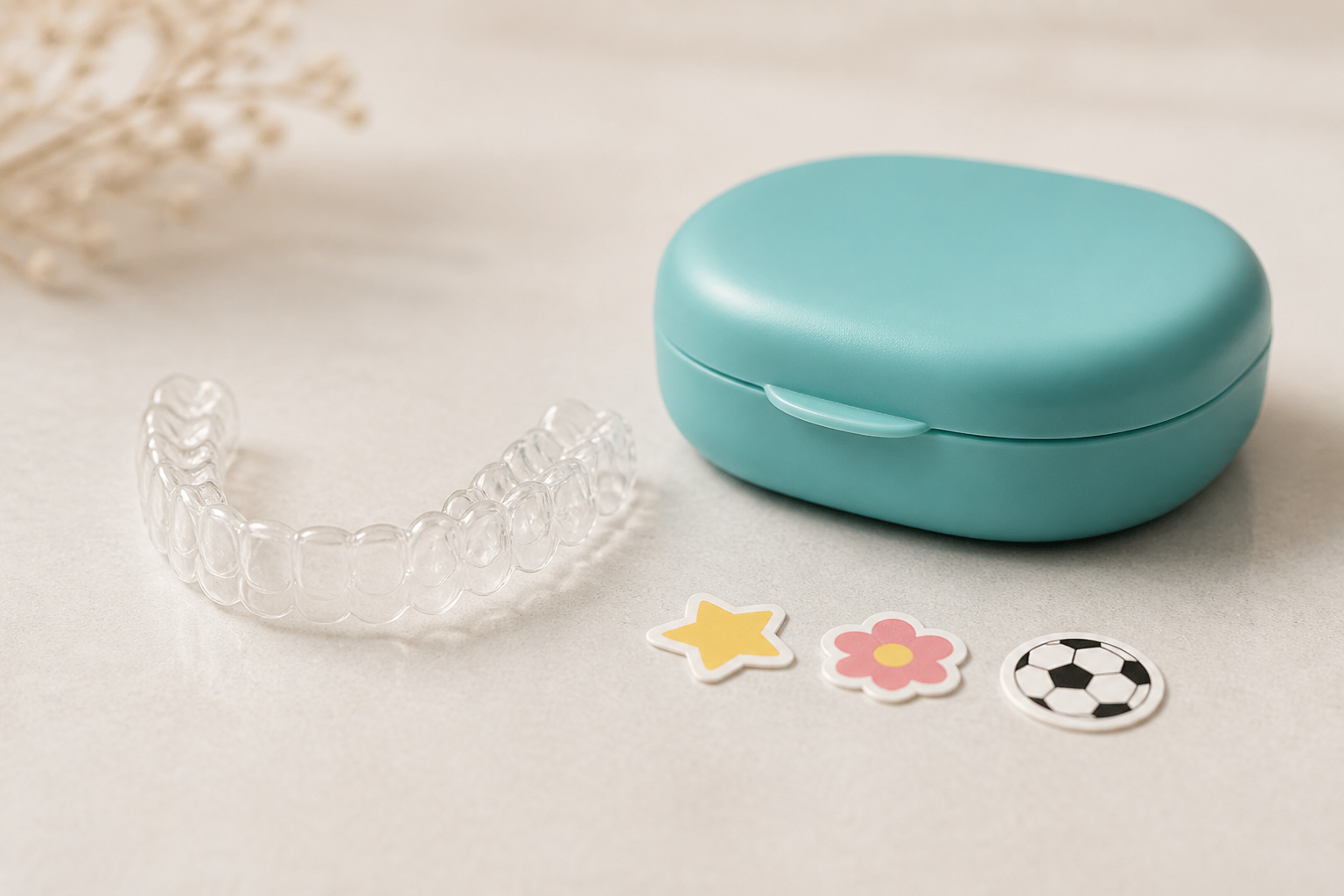
For children who enjoy color and expressing their creativity, we also offer Invisalign Stickables. These small decorative stickers can be used to personalize the aligners with fun designs such as emojis, flowers, shapes, soccer balls, and other playful options. It can be a simple way to make treatment feel more personal and enjoyable for younger patients.
How Long Phase 1 Lasts
Early orthodontic treatment often lasts approximately six to twelve months, although treatment time varies depending on the child's individual needs.
Phase 1 treatment is generally shorter than comprehensive orthodontic treatment because the goals are more focused. We are addressing specific developmental concerns rather than attempting to complete the final alignment of every permanent tooth.
After Phase 1, there is usually a resting or observation period while the remaining permanent teeth erupt. This period may last several years.
Many children later benefit from a second phase of orthodontic treatment during the early teenage years. Others may require only limited treatment or, occasionally, no additional treatment at all.
When Phase 2 is necessary, early treatment may make the later phase more straightforward by addressing certain developmental problems at the appropriate time.
Cost, Insurance, and Practical Details for Palm Beach County Families
What Phase 1 Costs Relative to Full Treatment
Phase 1 orthodontic treatment generally costs less than comprehensive treatment because it is shorter and more limited in scope.
Early treatment is recommended when addressing a problem at the right stage of growth can make future treatment more predictable and effective. Conditions such as a narrow arch, developing crossbite, significant crowding, or eruption concerns may be easier to manage in a younger, growing patient than later in adolescence.
When two phases of treatment are recommended, the overall cost may be similar to or slightly higher than the cost of a single phase of comprehensive treatment. In some cases, however, delaying treatment can lead to a more complex and longer comprehensive treatment later, which may also increase the overall cost.
We will review the expected benefits, treatment options, and associated costs with you so you can make a well-informed decision for your child.
Insurance, FSA, HSA, and Payment Plans
We accept most insurance plans, and orthodontic insurance benefits are commonly structured as a lifetime maximum per person rather than an annual benefit.
This is particularly important with two-phase treatment when a patient remains enrolled in the same insurance plan, because benefits used toward Phase 1 may reduce the amount available for Phase 2. However, if the insurance carrier or plan changes before Phase 2 begins, the patient may have a new orthodontic benefit that can be applied toward the second phase of treatment, depending on the terms of the new plan.
Our team will verify your child's orthodontic benefits and explain how the plan is expected to apply before treatment begins.
Orthodontic treatment may also qualify for payment through HSA and FSA funds. We offer in-house interest-free financing and also work with CareCredit and LendingPoint.
Lost and Broken Aligners
Lost aligners happen, particularly with younger children. An aligner may get wrapped in a napkin at lunch, left at school, or accidentally thrown away.
Fortunately, it is usually manageable.
Contact our office as soon as you realize an aligner is missing or damaged. Depending on where your child is in the treatment sequence, we may recommend returning temporarily to the previous aligner, moving forward to the next aligner, or ordering a replacement.
What we want to avoid is having your child go for an extended period without an aligner, because teeth can begin shifting away from the planned position.
Tips for Parents
- Create a consistent routine around meals. Aligners should be removed for eating and placed back in afterward. A predictable routine makes it easier for younger patients to stay consistent with wear time.
- Keep the aligner case easily accessible. A brightly colored case can be easier for children to keep track of, and having a spare in a backpack can be helpful. Avoid wrapping aligners in napkins, where they can easily be misplaced or accidentally discarded.
- Water is fine while wearing aligners. Aligners should be removed for juice, sports drinks, soda, and other sugary or acidic beverages to help reduce the risk of enamel damage and cavities.
- Communicate with your child's school. Most teachers and school staff are very accommodating once they understand that your child may need a few minutes at lunchtime to remove and replace aligners.
- Expect mild pressure with a new set. Temporary tightness or soreness is normal when changing to a new aligner and typically improves within a day or two.
- Encourage age-appropriate responsibility. Many children do very well when they are involved in managing their aligners, with parents providing guidance and supervision as needed.
Retention and Long-Term Follow-Up
Retention is important after early orthodontic treatment as well.
Once Phase 1 is completed, we may recommend a retainer or another type of holding appliance to preserve the correction while the remaining permanent teeth continue to erupt.
Without appropriate retention, some of the space or arch development achieved during treatment can be lost.
We also continue to monitor your child during the resting period between phases, generally every six to twelve months depending on development.
These visits are usually brief. We evaluate how the permanent teeth are erupting, how the jaws are growing, and whether a second phase of treatment will be necessary.
Determining the appropriate timing for additional treatment is an important part of early orthodontic care. Because every child grows and develops at a different pace, ongoing observation by the orthodontist helps ensure that treatment begins at the most appropriate stage of development.
What Makes Our Approach Different
Parsons Orthodontics is a private, boutique-style orthodontic practice, and Dr. Tetyana Parsons is a board-certified orthodontist who personally oversees her patients' treatment.
She develops your child's treatment plan and evaluates your child's progress throughout treatment.
Continuity of care is especially important in early orthodontics because it allows the orthodontist to observe changes in growth, tooth eruption, arch development, and bite over time. Having previous records and examinations as a reference point makes it possible to compare how your child's dentition has changed and to make treatment decisions based on that progression rather than evaluating each visit in isolation.
We also provide a full range of early orthodontic treatment options, including palatal expanders, functional appliances, space maintainers, traditional Phase 1 braces, and Invisalign First.
That means our recommendation is based on what is most appropriate for your child's individual needs rather than being limited to a single treatment option.
We welcome families from Lake Worth, Delray Beach, Boynton Beach, Wellington, West Palm Beach, and throughout Palm Beach County.
Frequently Asked Questions
Isn't six or seven too young for orthodontic treatment?
It is usually too early for comprehensive treatment involving every tooth, but it is not too early for an orthodontic evaluation.
The American Association of Orthodontists recommends that children receive their first orthodontic evaluation by age seven because certain problems can be identified, and in selected cases treated, more effectively while the jaws are still developing.
Many children evaluated at this age do not need immediate treatment. In those cases, we simply monitor growth and recommend treatment only when the timing is appropriate.
Will my child actually wear the aligners?
Many younger children do very well with clear aligners, particularly when families establish a consistent routine from the beginning.
Compliance indicators and regular orthodontic visits can help us evaluate whether the aligners are being worn appropriately.
If it becomes clear that a removable appliance is not working well for your child, we can discuss other treatment options rather than allowing valuable treatment time to be lost.
Does Invisalign First mean my child won't need braces later?
Not necessarily, and we would never promise that.
Phase 1 treatment is designed to guide development, address specific problems, and prevent certain conditions from becoming more difficult.
Many children will still benefit from a second phase of orthodontic treatment after the permanent teeth have erupted. The goal of early treatment is to address the right problems at the right time, not simply to eliminate the possibility of treatment later.
Is it painful?
Children generally experience pressure or mild soreness rather than sharp pain.
The aligners may feel tight or achy for the first day or two after changing to a new set, and that sensation usually improves quickly.
Because there are no brackets or wires, clear aligners also avoid some of the cheek and lip irritation that can occur with traditional braces.
How much does Invisalign First cost?
The cost depends on your child's individual treatment needs and the anticipated length and complexity of treatment.
At your complimentary consultation, we will provide a written treatment estimate, review applicable orthodontic insurance benefits, and explain available payment options.
Call us at 561.429.5414 to schedule an evaluation.
What if we do nothing right now?
Sometimes waiting is exactly the right choice, and we will tell you when it is.
Some orthodontic problems, if not addressed at the appropriate time, can lead to more significant complications, including impacted permanent teeth, increased risk of chipped or damaged teeth, loss of available space, and worsening of the bite as the child grows.
The purpose of an early orthodontic evaluation is to determine whether your child's situation would benefit from treatment now or whether continued observation is the better approach.
That way, choosing to wait is an informed clinical decision rather than simply a default.
Related Articles
- Phase 1 Orthodontics in Lake Worth
- Two-Phase Orthodontic Treatment in Lake Worth: A Parent's Guide
- The Importance of Early Orthodontic Treatment: A Real Case Study
- Invisalign Teen: A Discreet and Comfortable Way to Correct Misalignment
- How to Prepare Your Child for Their First Orthodontic Appointment
Ready to Schedule Your Free Consultation?
If your child is between six and ten and you have been wondering whether it's time for an orthodontic evaluation, we'd be happy to meet you.
Your first visit is complimentary and includes photographs, a panoramic X-ray, and a comprehensive examination by board-certified orthodontist Dr. Tetyana Parsons. There is no pressure or obligation to begin treatment.
Sometimes the best news we can give a parent is that nothing needs to be done yet. And when early treatment would be beneficial, we'll explain exactly why, what the options are, and what timing makes the most sense for your child.
Call us at 561.429.5414 or request an appointment online.
Let us design your beautiful smile!

