

Braces vs. Invisalign in West Palm Beach: How to Choose
May 13, 2026
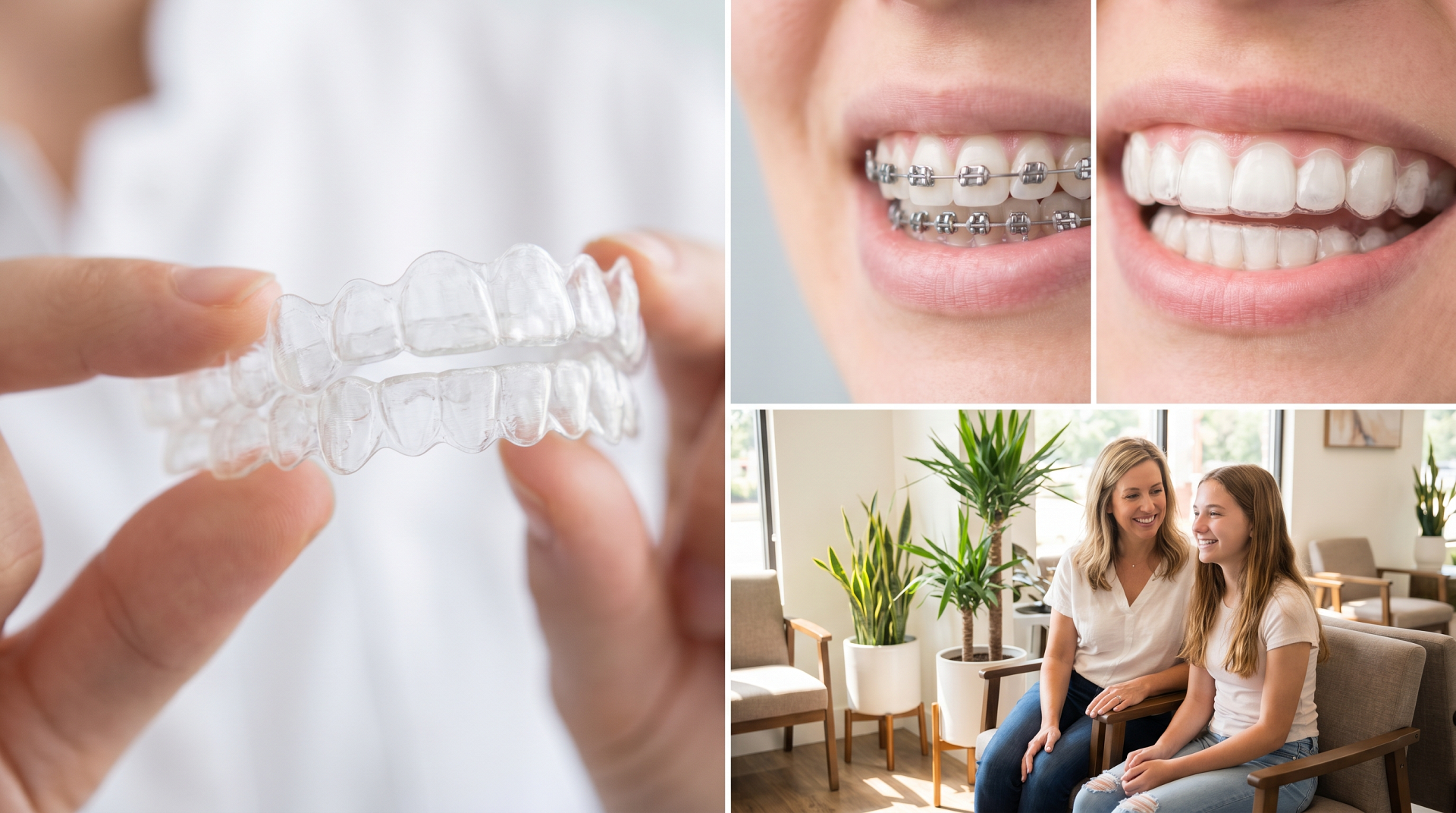
Braces vs. Invisalign
Stuck between braces and Invisalign? Almost every patient who walks into our Lake Worth office is asking the same question. Most have already spent hours online trying to figure it out, and most leave that research more confused than when they started. The answers are contradictory. The reviews are weirdly intense. Half the internet says Invisalign is a miracle and the other half says you’ll waste your money on a fancy mouthguard.
Both treatments work. Both can produce excellent results. The right choice depends on your specific case, your lifestyle, and how honest you’re willing to be with yourself about wear time.
Here’s how we walk patients through the decision when they sit down for a complimentary consultation. By the end of this guide, you should know which option is the better fit or at least know the questions to ask before committing.
Three Key Takeaways:
- Cost is closer than people think: Modern braces and Invisalign land in a similar price range for most cases. The “Invisalign costs way more” idea is mostly outdated.
- The best option depends on your case, not your preference: Some bites need braces. Some are perfect for Invisalign. A consultation tells you which category you’re in.
- Compliance is the deciding factor for borderline cases: If you can’t commit to wearing aligners 22 hours a day, braces will get you a better result. There’s no shame in admitting that upfront.
What Are Your Options? A Quick Refresher
Before we compare, it helps to be clear about what each treatment actually is. Most people lump every type of brace together and treat Invisalign as one product. Both are oversimplifications.
Traditional Metal Braces
Stainless steel brackets bonded to the front of each tooth, connected by a thin archwire. The wire applies steady pressure, and the brackets translate that pressure into specific tooth movements. Modern metal braces are smaller, smoother, and faster than the ones you remember from middle school.
Ceramic (Clear) Braces
Same mechanics as metal, but the brackets are tooth-colored ceramic. They blend in from a normal conversational distance. Adults who want fixed appliances but don’t want the metallic look usually end up here.
Self-Ligating Braces
Brackets with built-in clips instead of elastic bands holding the wire in place. Less friction, fewer adjustment appointments, and often a more comfortable experience day-to-day. Available in both metal and ceramic.
Lingual Braces
Braces bonded to the back of your teeth instead of the front. Completely invisible from the outside. They have a learning curve and a higher price tag, but for adults in client-facing roles, they’re a real option worth knowing about.
Invisalign
A series of clear, custom plastic trays you wear 20 to 22 hours a day. You take them out to eat, drink anything other than water, and brush. Each tray is worn for one to two weeks before swapping to the next. Most cases also use small tooth-colored attachments bonded to certain teeth to enable specific movements.
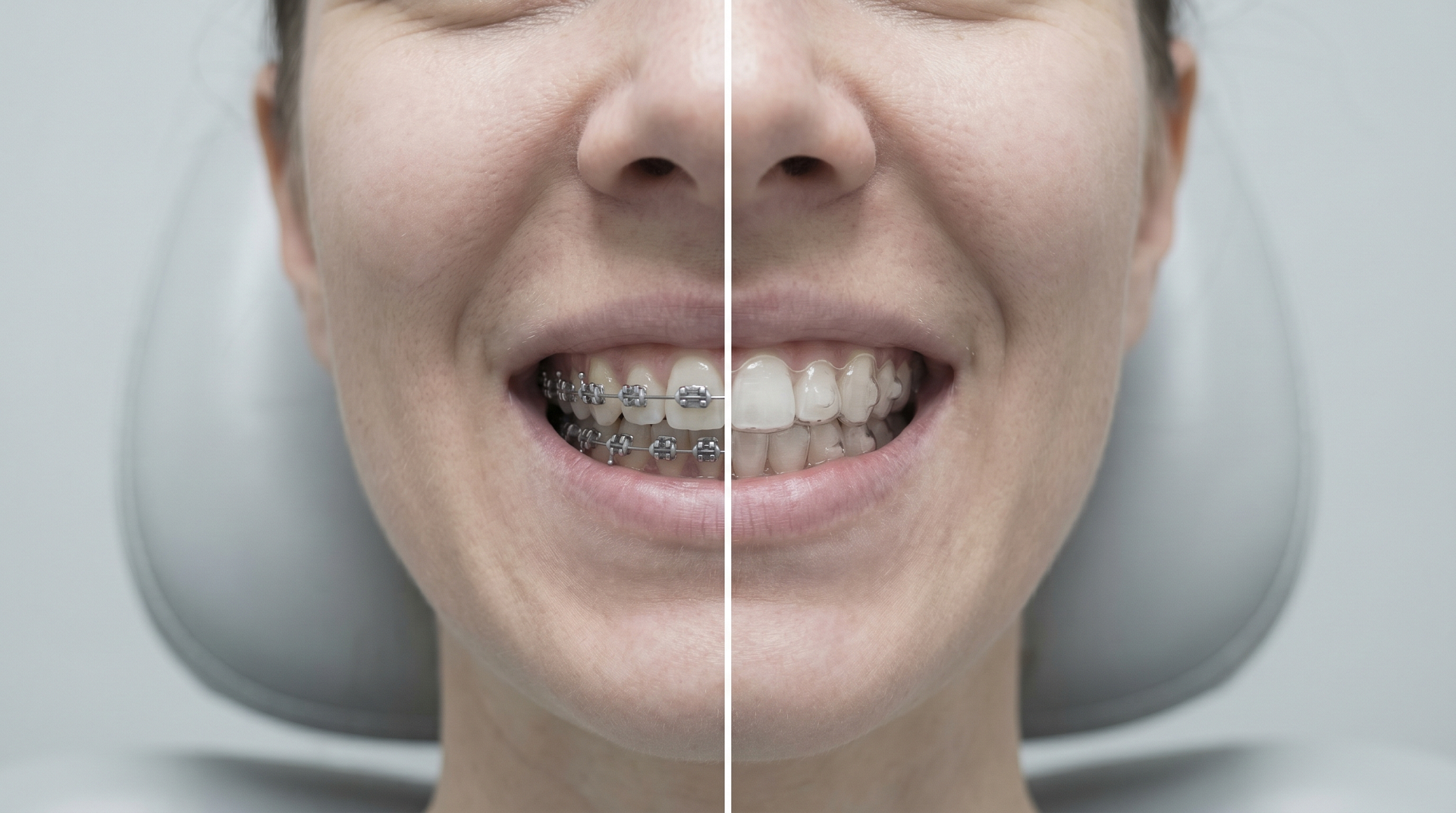
How Braces and Invisalign Compare on the Things That Matter
Let’s go category by category. These are the questions patients ask, and the honest answers based on what we see in our practice every week.
Cost
In our practice, traditional metal braces, ceramic braces, and Invisalign land in a similar overall range. Lingual braces tend to run significantly higher due to complexity of technique involved. The exact number depends on the complexity of your case, not the appliance you choose.
Most insurance plans that cover orthodontics cover both braces and Invisalign the same way, with the same lifetime maximum. We accept most major dental insurance, HSA and FSA, CareCredit, LendingPoint, and offer in-house interest-free financing for patients who prefer to keep things simple. We give you actual numbers at your consultation, not ranges.
Treatment Time
Treatment length depends far more on the complexity of your case than the type of appliance used. A straightforward case might be 9 to 12 months in either braces or Invisalign, while more complex bite correction might run 24 months or longer regardless of the method.
Where differences can arise is in the patient compliance. Invisalign requires consistent wear. Aligners that sit on the nightstand can’t move teeth. We sometimes see Invisalign cases extend beyond original timeline due to insufficient wear.
However, it is important to note that braces also require compliance, especially when it comes to bite correction. Both braces and Invisalign can effectively align teeth, but bite correction often depends on additional steps, most commonly the consistent use of elastics (rubber bands). Without proper elastics wear, even braces cannot fully achieve the desired bite correction.
Ultimately, successful orthodontic treatment, whether with braces or Invisalign, relies on the patient cooperation to deliver the best possible result.
Aesthetics
Invisalign typically comes out ahead in this category for most patients. The aligners are nearly invisible at a normal conversational distance. While the small attachments may be noticeable up close, they’re generally not visible from across the room.
That said, ceramic braces are much less noticeable than many people expect. If aesthetics are the main reason you’re leaning toward Invisalign, it’s worth knowing there are a few discreet options available.
Comfort
Both treatments cause some discomfort, especially in the first few days and after adjustments or tray changes. Braces patients deal with bracket and wire irritation against the cheeks and lips, especially early on. Invisalign patients deal with pressure soreness when switching to a new tray.
In our experience, Invisalign tends to be slightly more comfortable overall, but the difference isn’t dramatic. Modern braces are a lot smoother than they used to be. Patients adapt to either one within a couple of weeks.
Daily Life and Eating
This is where the two treatments differ the most. With braces, you do need to be more mindful with certain foods, especially those that are hard, sticky, or chewy, since they can damage a bracket or get caught in a wire. Many foods don’t have to be completely avoided, though. Items like apples or carrots can still be enjoyed if they’re cut into smaller pieces. It’s a simple adjustment, but one that needs to be followed throughout treatment.
With Invisalign, you can eat whatever you like since the trays are removable. However, they need to be taken out not only for meals but also for any drinks other than water, such as coffee, tea, or soda. This can be inconvenient for some patients and may take a little time to get used to.
Hygiene
With Invisalign, it’s generally easier to keep your teeth clean since you can remove the trays and brush and floss normally. That said, it still requires consistency. Regular brushing and good hygiene are essential to keep both your teeth and the aligners clean.
With braces, brushing takes more time, and flossing often requires threaders or special tools. Patients who don’t stay on top of their hygiene during braces treatment can develop white spot lesions or cavities.
For both options, maintaining good oral hygiene is essential. Brushing and flossing multiple times a day helps keep teeth clean and gums healthy.
Predictability of Results
For straightforward cases, both treatments produce excellent results. In more complex cases, such as severe rotations or impacted teeth, braces still tend to have an edge in predictability, as wires and brackets allow for more direct control of individual tooth movement and the use of auxiliaries.
That said, Invisalign has advanced significantly over the past decade and can now successfully treat a much wider range of cases than before. Dr. Parsons evaluates each patient individually rather than applying a one-size-fits-all approach.
In some situations, a hybrid approach can be helpful for specific treatment needs. For example, an Invisalign patient with a severely rotated tooth may benefit from the temporary use of a bracket to help correct that rotation more efficiently. Both braces and Invisalign are tools in a toolbox, and Dr. Parsons can combine them when needed to achieve the best possible outcome in the most efficient treatment time.
Which Treatment Fits Which Patient?
Generalizations can only take you so far, but here are the patterns we see most often.
Invisalign Tends to Be a Strong Fit For
- Adults in client-facing professions in West Palm Beach or Boynton Beach who want a discreet option
- Disciplined teens motivated by aesthetics and willing to commit to wear time
- Patients with mild to moderate crowding, spacing, or bite issues
- Patients who play wind instruments or contact sports where brackets would be a problem
- Patients with a history of good dental hygiene and follow-through
Braces Tend to Be a Strong Fit For
- Patients with impacted teeth or significant tooth rotations
- Patients who don’t want to think about removing trays multiple times a day
- Patients who want self-expression through colored elastics
What Will the Treatment Process Actually Look Like?
Here’s what to expect from start to finish with each option.
The Braces Journey
Bracket placement takes about an hour. There’s no drilling and no shots, just a series of steps where we prep each tooth and bond the brackets in place. You leave with a full set of brackets and an archwire already in place.
You come in every four to eight weeks for adjustments. Each appointment takes 15 to 30 minutes. You’ll see Dr. Parsons in person at these visits to evaluate your treatment progress, and during this appointment adjustments to wires and elastics will be made. Total time in the chair across treatment is usually less than people expect.
At the end, we remove the brackets, polish the teeth, and take impressions for retainers. You walk out with the smile we’ve been working toward and a retention plan to keep it.
The Invisalign Journey
We start with digital scans (no goopy impressions). Dr. Parsons designs your treatment plan using 3D imaging software, and you can see your projected results before you commit. Once you approve the plan, your trays are manufactured and shipped to our office.
At your first or second Invisalign appointment, we bond your attachments and walk you through how to insert and remove the aligners. You leave with several weeks of trays and a schedule.
Check-ins happen every six to ten weeks. Visits are quick, usually 15 to 20 minutes. Dr. Parsons will evaluate your tracking in person at these visits, and afterwards we will provide you with your next set of trays. At the end, we remove the attachments, polish your teeth, and move you into retainers.
Practical Considerations for South Florida Patients
Florida Heat and Daily Routines
A small thing that matters more than people expect. Don’t leave your Invisalign trays in your car. Florida heat will warp them in under an hour. Braces don’t care about temperature, which is one less thing to think about for patients who spend a lot of time outdoors.
Snowbird and Travel Schedules
We have many patients who split time between South Florida and somewhere up north. Invisalign works well for these schedules because we can send you with several weeks of trays at once. Braces require in-person adjustments, so the schedule is a bit more locked in. Both can work, but Invisalign offers more flexibility for patients who travel often.
College Students
For college students who are away from home for extended periods, Invisalign can be a convenient option. We can provide multiple sets of trays in advance, making it easier to stay on track with treatment between visits.
Braces still require periodic in-person adjustments, which means planning appointments around school breaks or trips home. Both options are doable, but Invisalign often provides more flexibility for students with busy or changing schedules.
Sports and Activities
For patients involved in contact sports, both Invisalign and braces require the use of a mouthguard. However, with braces there is a higher risk of bracket or wire damage during impact, even with protection in place. Invisalign aligners can simply be removed during play, which may reduce the risk of appliance breakage.
For wind instrument players, both options have a learning curve, but Invisalign tends to be easier to adapt to.
Tips for Making the Right Choice
A handful of things that’ll help you decide with confidence.
- Be honest about your discipline. Invisalign only works if you wear it. If you know you’ll forget, take it out and not put it back in, or “just this once” your way through treatment, choose braces.
- Don’t pick on aesthetics alone. Ceramic braces solve the look problem without the compliance problem.
- Ask about your specific case. Listen to Dr. Parsons’ recommendation based on your specific case. Some dental issues, such as impacted teeth or severe rotations, may be more effectively treated with braces or may require a hybrid approach. Not every case is ideal for both options, so a personalized evaluation is key.
- Compare actual quotes, not online averages. The cost difference between options at our practice is often smaller than what you’ll find on a generic cost-comparison article.
- Think about the next two years, not just the next week. The choice you make affects your daily routine for the entire treatment. Picture yourself doing it.
What Makes Choosing at Parsons Orthodontics Different?
We offer a variety of braces and Invisalign treatment options for children, teens, and adults. This includes both limited and comprehensive treatment plans, depending on your needs. Because we provide multiple options, we don’t have a financial incentive to steer you toward one specific approach. The recommendation you receive is based on what’s best for your individual case.
Dr. Parsons Plans and Monitors Every Case Personally
Whether you choose braces or Invisalign, Dr. Parsons reviews and finalizes your treatment plan. We don’t outsource case planning. The result reflects her clinical judgment, not a software default. She also evaluates patients in person at every appointment to monitor progress, ensuring treatment is delivered to the highest standard and completed in the shortest, most efficient time possible.
Complimentary Consultations
Your free consultation includes a panoramic x-ray, photos, and a thorough orthodontic exam. You leave knowing what your options are, what each one would cost, and what your timeline would look like. No deposit required and no pressure to commit.
Flexible Financing for Either Option
In-house interest-free financing is available for both braces and Invisalign cases. We accept most major dental insurances, HSA and FSA, CareCredit, and LendingPoint. The financial side shouldn’t be the reason you choose one over the other.
We Treat Every Age Group
We offer Phase I (interceptive) treatment for patients as young as 6 to 7 years old, as well as treatment for teens and adults, including many patients in their 50s, 60s, and even 70s. The guidance you receive is based not only on your specific orthodontic needs, but also on your stage of life and individual goals.
Frequently Asked Questions About Braces vs. Invisalign
Are braces faster than Invisalign?
Not inherently. The same case in either treatment usually finishes in roughly the same amount of time. Invisalign can be slower in practice if a patient doesn’t wear the aligners enough. For complex movements, braces sometimes have a slight edge in efficiency.
Can I switch from braces to Invisalign mid-treatment?
In some cases, yes. We’ve done this for patients whose circumstances changed during treatment. It’s not always the right call, and it can affect overall cost and timeline, but it’s a conversation worth having if you’re struggling with your current option.
Which is better for severe overbites or underbites?
Severe bite issues have traditionally responded better to braces, particularly when significant bite correction is needed. However, with advances in technology, Invisalign patients can now also achieve full overbite and underbite correction in many cases. That said, Dr. Parsons evaluates each case individually to determine the most effective and efficient treatment approach.
Do braces or Invisalign hurt more?
Both cause some discomfort, especially in the first few days and after each adjustment or tray change. Most patients describe it as pressure rather than pain. Invisalign tends to be slightly more comfortable overall because there are no brackets rubbing against the cheeks. The difference is small.
Is Invisalign covered by insurance the same as braces?
In most cases, yes. Insurance plans that cover orthodontics typically cover Invisalign and braces equally, applying the same lifetime maximum to either option. We verify your coverage before you commit so there are no surprises.
Which one needs a retainer afterward?
Both. Always. Teeth want to drift back to where they started no matter which appliance moved them. Retainers are part of every treatment plan, and we discuss your retention strategy well before you finish.
Ready to Find Out Which Option Is Right for You?
You don’t have to choose before your consultation. That’s exactly what the consultation is for. We do the x-ray, take the photos, look at your bite, and give you our honest recommendation along with realistic numbers and a timeline for each option you’re considering.
We see patients from across South Florida including Lake Worth, Boynton Beach, Wellington, West Palm Beach, and Delray Beach. Call us at 561.429.5414 or request a complimentary consultation through our contact page.

