

Are At-Home Clear Aligners Safe? What to Know Before You Order
September 22, 2026

At-home clear aligners are often marketed as a less expensive and more convenient way to straighten your teeth without regular visits to an orthodontic office. The lower price can certainly be appealing. However, recent developments involving two prominent direct-to-consumer aligner companies highlight an important consideration: orthodontic treatment involves much more than simply receiving a series of plastic trays.
SmileDirectClub ceased operations in December 2023 while many customers were still undergoing treatment. Byte voluntarily suspended sales and marketing of its at-home aligners and impression kits in October 2024 and later announced that the at-home Byte aligner system would not be reinstated for new patients.
These events reinforce an important question for anyone considering orthodontic treatment: Who is diagnosing, supervising, and remaining responsible for your care throughout treatment?
Here is how the direct-to-consumer model works, the clinical concerns patients should understand, and the questions we believe anyone in Lake Worth or Palm Beach County should ask before beginning clear aligner treatment of any kind.
Key Takeaways
- At-home aligner treatment may begin without the same level of in-person diagnostic evaluation used in traditional orthodontic care. Without an appropriate clinical examination and diagnostic imaging, certain conditions involving the roots, supporting bone, gums, or unerupted teeth may not be identified before tooth movement begins.
- Orthodontic tooth movement should occur on a healthy foundation. Untreated periodontal disease, decay, significant bone loss, infection, or other dental conditions should be identified and appropriately managed before orthodontic forces are applied.
- Two prominent direct-to-consumer aligner providers are no longer offering at-home treatment to new patients. SmileDirectClub ceased operations in December 2023. Byte suspended sales in October 2024 and subsequently discontinued offering its at-home aligner system to new patients.
- Continuity of care matters. Orthodontic treatment may continue for many months, followed by lifelong retention. Patients should know who will monitor their treatment, manage unexpected problems, provide retainers, and remain responsible for follow-up care.
- Clear aligners themselves are not the concern. Invisalign and similar systems can be highly effective when appropriately prescribed and monitored. The important distinction is the diagnosis, treatment planning, clinical supervision, and follow-up surrounding the appliance.
What Are At-Home Clear Aligners?
How the Mail-Order Model Works
Most direct-to-consumer aligner companies have traditionally followed a similar model:
- You take your own dental impressions with a mailed kit or receive a scan at a retail location
- A treatment plan is generated remotely
- A licensed dentist or orthodontist reviews and approves the case from a distance
- A series of aligners is shipped directly to your home
- You change aligners according to a predetermined schedule
- Monitoring, when provided, may rely primarily on photographs or scans uploaded through an app
In many direct-to-consumer models, treatment may begin without an in-person examination by the clinician who is responsible for the orthodontic treatment.
How It Differs from Orthodontist-Supervised Treatment
The plastic trays themselves are not the primary difference. The major differences are the diagnostic process and the level of clinical supervision.
When we treat a clear aligner case at Parsons Orthodontics, we examine the patient in person, obtain appropriate diagnostic records, evaluate the roots and the bone supporting the teeth, assess periodontal health, examine the bite, and design the tooth movements based on the individual patient's needs. We then monitor progress throughout treatment to make sure the teeth are responding as expected.
Digital orthodontic treatment plans are predictions of how teeth are expected to move. Teeth do not always respond exactly as anticipated. When they do not, clinical examination allows the orthodontist to identify the problem and modify the treatment plan when necessary.
In a primarily remote model, monitoring may depend heavily on photographs, scans, or information submitted electronically. Although remote monitoring can be useful in appropriate circumstances, it does not provide all of the information available during an in-person clinical examination.
What Happened to SmileDirectClub and Byte?
The SmileDirectClub Shutdown
SmileDirectClub treated millions of customers between 2014 and 2023. The company filed for Chapter 11 bankruptcy protection in September 2023 and announced the wind-down of its global operations in December 2023. The shutdown affected patients who were still undergoing treatment and ended services that had previously been included with treatment plans, including the company's Lifetime Smile Guarantee. The bankruptcy proceeding was subsequently converted to Chapter 7. Some customers reported losing access to services, treatment support, and aligners they had not yet received.
In December 2024, the New York Attorney General announced a $4.8 million recovery benefiting more than 28,000 consumers nationwide who had been improperly charged after SmileDirectClub ceased providing treatment services.
The Byte Suspension and Discontinuation
Byte, owned by Dentsply Sirona, voluntarily suspended sales and marketing of its aligners and impression kits on October 24, 2024. The company stated that the decision was made while reviewing regulatory requirements in communication with the FDA.
Concerns were identified regarding whether the remote onboarding process adequately screened patients for certain conditions that could make aligner treatment inappropriate without further dental evaluation. Byte advised certain existing patients to stop treatment and seek evaluation from a dental professional if they had specific medical or dental conditions or developed certain symptoms. In January 2025, Dentsply Sirona announced that it would not reinstate the at-home Byte Aligner System for new patients while continuing support for certain existing patients. The company also recorded substantial financial impairments related to the Byte business.
What These Developments Show
Both SmileDirectClub and Byte were highly visible companies that were widely marketed to consumers. Their experiences illustrate why continuity of care matters during orthodontic treatment. Orthodontic treatment commonly lasts 12 to 24 months, and retention continues long after active treatment ends. Patients should consider not only the aligner product itself but also who will remain responsible for their care throughout treatment and afterward. Before beginning care, patients should understand who will evaluate them, how treatment will be monitored, what happens if treatment does not progress as anticipated, and who will provide follow-up care after active tooth movement is complete.
What Are the Risks of At-Home Aligners?
Treatment May Begin Without Complete Diagnostic Records
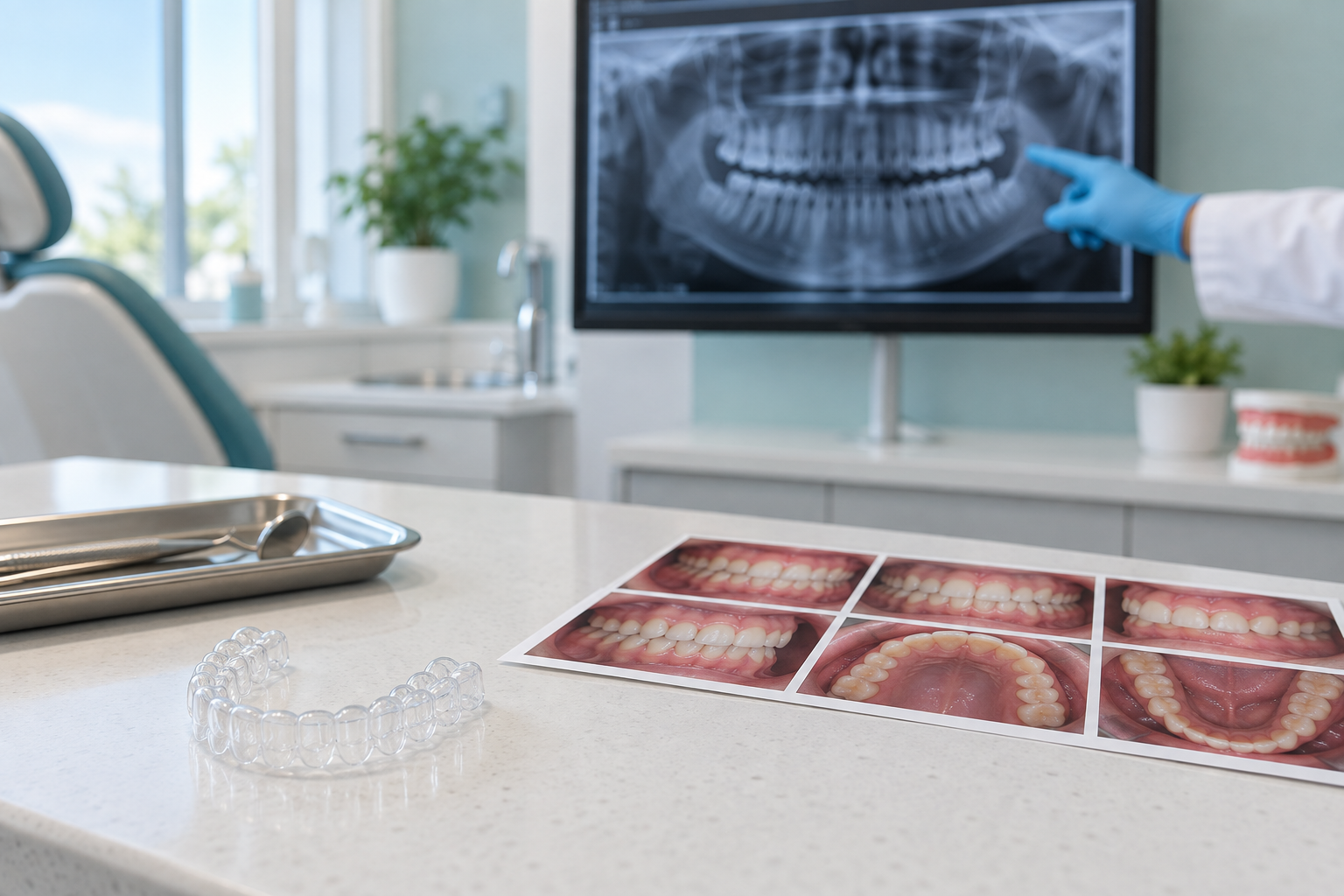
A panoramic x-ray can provide valuable information about root position, bone levels, unerupted or impacted teeth, and other conditions that cannot be evaluated from a photograph, selfie, or home impression alone. Diagnostic records are an important part of determining whether orthodontic tooth movement is appropriate and what type of treatment is best for an individual patient.
Existing Conditions May Go Undetected
Orthodontic force should be applied only after the health of the teeth and supporting tissues has been appropriately evaluated.
Conditions that may need to be identified and managed before treatment begins include:
- Active gum disease or bone loss
- Untreated decay
- Failing or loose crowns, bridges, or fillings
- Root resorption from previous treatment
- Impacted or unerupted teeth
- Loose teeth or reduced bone support
- Abscesses or infections
Some of these conditions can be present without noticeable symptoms, which is one reason proper diagnostic evaluation is important before orthodontic treatment begins.
Straight Teeth Do Not Always Mean a Healthy Bite
Straightening the visible front teeth and establishing a healthy, functional bite are not necessarily the same objective. Orthodontic treatment planning considers both the alignment of the teeth and how the upper and lower teeth come together. An inadequately evaluated bite may contribute to uneven tooth contacts, wear, instability, or other functional concerns. For this reason, orthodontic treatment should consider the entire dentition rather than focusing only on the appearance of the front teeth.
Clear aligners can correct many types of bite problems when the case is appropriately diagnosed, treatment-planned, and supervised.
The Importance of Monitoring Tooth Movement and Aligner Fit
A digital treatment simulation represents the intended movement of the teeth. It does not guarantee that every tooth will move exactly as predicted.
During supervised orthodontic treatment, progress examinations allow the orthodontist to confirm that the aligners are fitting properly and that the teeth are responding as planned. If tracking is incomplete, the orthodontist can modify the treatment plan, change the schedule for changing them, adjust attachments or treatment mechanics, prescribe additional aligners, or consider another treatment approach.
When monitoring is primarily remote, problems may be more difficult to identify promptly. Delayed recognition of tracking problems can prolong treatment and make treatment correction more complicated.
Limited Recourse
When a direct-to-consumer company ceases operations, patients may be left without ongoing clinical support, remaining aligners, access to promised services, or long-term follow-up. Patients may then need to seek another provider and incur additional costs to complete or correct treatment.
The American Association of Orthodontists has published consumer guidance regarding direct-to-consumer orthodontic treatment and has encouraged appropriate reporting of adverse events associated with orthodontic products.
Benefits of Professional Orthodontic Supervision
An orthodontist-supervised clear aligner case should include:
- An in-person examination before treatment is recommended
- X-rays showing roots, bone levels, and developing or impacted teeth
- Evaluation of gum and bone health before orthodontic force is applied
- Assessment of the bite, not simply the appearance of the front teeth
- A treatment plan designed for the individual patient's needs
- Regular progress examinations
- Adjustments or treatment-plan revisions when teeth are not tracking as expected
- Coordination with the patient's general dentist or other specialists when restorative or periodontal treatment is involved
- Retention planning and long-term follow-up
- Access to a local office and doctor throughout treatment
Dr. Tetyana Parsons is a board-certified orthodontist. She personally performs the examination, designs the orthodontic treatment plan, and monitors each patient's progress throughout treatment.
Cost Comparison: Mail-Order Aligners vs. In-Person Orthodontist-Supervised Treatment
Direct-to-consumer aligners have historically cost less than comprehensive orthodontist-supervised treatment. Cost is understandably one of the main reasons patients consider them. However, the initial treatment fee should be considered together with the services included in treatment.
Professionally in-person supervised orthodontic care may include:
- An in-person clinical examination
- Diagnostic photographs and x-rays
- Evaluation of periodontal and dental health
- Comprehensive bite evaluation
- Individualized treatment planning
- Physical progress monitoring
- Mid-treatment adjustments or revised treatment plans when necessary
- Coordination with your dentist or other specialists
- Retention planning
- Long-term follow-up
- Professional accountability throughout treatment
For that reason, it is useful to compare not only the initial fee but also what diagnostic care, treatment supervision, revisions, retention, and follow-up are included.
Parsons Orthodontics offers in-house interest-free financing, accepts HSA and FSA payments, works with CareCredit and LendingPoint, and accepts most insurance plans with orthodontic benefits. For many patients, these flexible payment options make professionally supervised orthodontic treatment more affordable and easier to fit within their monthly budget.
Questions to Ask Before Ordering Any Aligner
- Will anyone examine my teeth in person before treatment begins?
- Will appropriate x-rays be taken and reviewed?
- Who is the licensed doctor responsible for my treatment, and where are they located?
- Is that doctor a dentist or an orthodontic specialist?
- How will my progress be monitored, and how often?
- Will I have access to an in-person examination if a problem develops?
- What happens if my teeth do not move as planned?
- Does the treatment plan address my bite as well as the appearance of my teeth?
- Are retainers included, and what happens when they wear out?
- Who will provide long-term follow-up care?
- What happens if the company or provider stops operating during my treatment?
- Who do I contact locally if something goes wrong?
Recent developments in the direct-to-consumer aligner industry have made these questions particularly important.
What to Do If You Already Started At-Home Treatment
If You Are Mid-Treatment
If you are currently wearing at-home aligners and your provider has stopped operating or you no longer have access to clinical supervision, schedule an orthodontic evaluation.
Do not make significant changes to your treatment without professional guidance unless you are experiencing symptoms that warrant stopping aligner wear.
Bring everything you have to the appointment, including remaining aligners, scans, treatment-plan documents, and any other available records.
An orthodontist can evaluate your current tooth positions, bite, periodontal health, and treatment progress and recommend the safest next step.
If Your Teeth Shifted After Treatment Ended
Some tooth movement after orthodontic treatment can occur, particularly when retainers are not worn consistently or when there is no ongoing retention plan.
An orthodontic evaluation can determine whether retainers alone may be appropriate to maintain the current position or whether limited orthodontic retreatment would be beneficial.
What to Do If You Experience Significant Discomfort, Tooth Mobility, or a Traumatic Bite
Mild pressure or temporary tenderness can occur during normal orthodontic tooth movement.
However, significant or persistent pain, unusual tooth mobility, worsening gum recession, swelling, or a concerning change in your bite warrants professional evaluation.
If you experience these symptoms, do not advance to the next aligner until you have been evaluated by a dentist or orthodontist.
Retention and Long-Term Follow-Up
Retention is an essential part of orthodontic treatment because teeth can continue to shift throughout life. After active orthodontic treatment, many patients transition from more frequent retainer wear to long-term nighttime wear.
At Parsons Orthodontics, we recommend lifelong nighttime retainer wear to help maintain the orthodontic result.
Retainers also require periodic evaluation and replacement. They can stretch, crack, distort, or gradually lose their ability to maintain tooth position. Patients who clench or grind their teeth may need replacement more frequently.
At Parsons Orthodontics, post-treatment follow-up allows us to evaluate retainer fit, tooth position, bite stability, and early signs of unwanted tooth movement.
Orthodontic Care in Lake Worth and Palm Beach County
Parsons Orthodontics is a private, boutique-style orthodontic practice serving patients throughout Palm Beach County, including Lake Worth, Delray Beach, Boynton Beach, Wellington, West Palm Beach, Greenacres, and Royal Palm Beach.
We offer Invisalign along with metal braces, ceramic clear braces, self-ligating braces, and other orthodontic appliances, so our recommendation is based on your individual case rather than on a single treatment product.
If you have been considering mail-order aligners, a complimentary consultation can help you understand the complexity of your bite, review your treatment options, and learn the importance and benefits of in-person orthodontic supervision in achieving the best possible treatment outcome as efficiently as possible. We will also review treatment costs, insurance benefits, and flexible financing options designed to help make orthodontic care affordable and easier to fit within your monthly budget.
Frequently Asked Questions
Are at-home clear aligners safe?
At-home aligners are capable of moving teeth, but safe orthodontic treatment depends on appropriate diagnosis, treatment planning, and monitoring. The main concern with predominantly remote aligner treatment is that treatment may begin without the same in-person clinical examination and diagnostic evaluation routinely used in orthodontic care. Certain dental, periodontal, skeletal, or bite conditions may therefore be more difficult to identify before or during treatment.
Is Invisalign the same as a mail-order aligner?
No.
Invisalign is an orthodontic treatment system prescribed by a dentist or orthodontist. In a professionally supervised case, the provider examines the patient, reviews diagnostic records, develops the treatment plan, and monitors progress throughout treatment.
Mail-order aligner systems have historically relied much more heavily on remote evaluation and monitoring.
Can at-home aligners damage your teeth?
Any orthodontic treatment involves applying controlled forces to move teeth, and safe treatment depends on appropriate diagnosis, treatment planning, and ongoing monitoring.
A patient's dental and periodontal health is dynamic and can change during treatment due to changes in overall health, medications, oral hygiene, habits, or other factors. Conditions such as gum inflammation, reduced bone support, root changes, or changes in the bite may develop or become more significant during the course of treatment.
Orthodontic tooth movement is also a dynamic biological process. Teeth do not always move exactly as predicted by a digital treatment plan, and the way the bite develops can change as treatment progresses.
For these reasons, regular clinical monitoring is an important part of orthodontic care. In-person evaluations allow the orthodontist to assess dental and periodontal health, confirm that the teeth are moving as expected, evaluate the developing bite, and make adjustments when needed. These adjustments may include modifying the aligners, changing the schedule for aligner changes, adjusting attachments or treatment mechanics, or revising the treatment plan.
The concern with mail-order aligners is therefore not simply the aligners themselves, but whether there is adequate diagnosis, in-person clinical supervision, and ongoing monitoring to recognize changes early and adjust treatment appropriately.
Is SmileDirectClub still in business?
No.
SmileDirectClub filed for Chapter 11 bankruptcy protection in September 2023 and announced the wind-down of its global operations in December 2023. Its bankruptcy proceeding was later converted to Chapter 7.
Can I still buy Byte aligners?
Byte suspended sales and marketing of its at-home aligners and impression kits in October 2024.
In January 2025, Dentsply Sirona announced that the at-home Byte Aligner System would not be reinstated for new patients while continuing support for certain existing patients.
I'm mid-treatment with a company that closed. What now?
Schedule an orthodontic evaluation.
Bring any remaining aligners, scans, treatment documents, and other records you have available.
Dr. Parsons can examine your teeth, obtain appropriate diagnostic records, evaluate your bite and treatment progress, and explain what may be needed to safely complete or correct treatment.
Are mail-order aligners cheaper than Invisalign?
Direct-to-consumer aligners have historically cost less up front than comprehensive orthodontist-supervised treatment.
However, patients should also consider what is included in that fee.
Professionally supervised treatment typically includes diagnostic evaluation, treatment planning, office visits, progress monitoring, management of unexpected changes, and retention planning.
Do I need x-rays before clear aligner treatment?
X-rays provide information that cannot be seen during a visual examination alone. They can help evaluate root position, supporting bone, developing or impacted teeth, and other conditions that may affect orthodontic treatment planning.
At Parsons Orthodontics, a panoramic x-ray is included as part of your complimentary orthodontic consultation.
Can clear aligners fix my bite, or only straighten my front teeth?
Clear aligners can correct many types of bite problems when the case is appropriately diagnosed, treatment-planned, and supervised. Whether clear aligners are appropriate for your particular bite depends on the type and complexity of tooth movement required.
An orthodontic examination helps determine the best treatment approach.
What if my case is too complex for aligners?
Some orthodontic problems may be treated more predictably with braces, other appliances, or a combination of treatment approaches.
Because Parsons Orthodontics offers metal braces, ceramic clear braces, self-ligating braces, Invisalign, and other orthodontic appliances, treatment recommendations are based on the patient's individual needs rather than on a single available product.
Does insurance cover clear aligner treatment?
Many dental insurance plans include an orthodontic benefit, often structured as a lifetime maximum per person rather than an annual benefit.
Coverage varies by insurance plan.
Our team can review your specific orthodontic benefits and help you understand how they may apply to treatment. Call 561-429-5414 to have your orthodontic benefits reviewed.
How do I know if a provider is an orthodontist?
An orthodontist is a dentist who has completed an accredited full-time orthodontic residency after dental school. You can also ask whether the orthodontist is board certified. Board certification is an additional voluntary credential that demonstrates completion of the certification process established by the American Board of Orthodontics.
Dr. Tetyana Parsons is a board-certified orthodontist.
Related Articles
- Orthodontist in Delray Beach, FL: Braces, Invisalign & Family Orthodontic Care
- Braces vs. Invisalign in West Palm Beach: How to Choose
- Invisalign in Lake Worth, FL: The Complete Guide
- How Much Are Invisible Braces? Clear Aligners Cost Guide
- Invisalign Attachments: What They Are and Why They Matter
Ready to Schedule Your Free Consultation?
If you have been comparing clear aligner options, one of the most useful next steps is finding out what your individual case actually involves.
Your first visit at Parsons Orthodontics is complimentary and includes photographs, a panoramic x-ray when clinically appropriate, and a comprehensive orthodontic examination with board-certified orthodontist Dr. Tetyana Parsons.
There is no obligation to begin treatment.
Call us at 561-429-5414 or request an appointment online.
Let us design your beautiful smile!

